
In this article
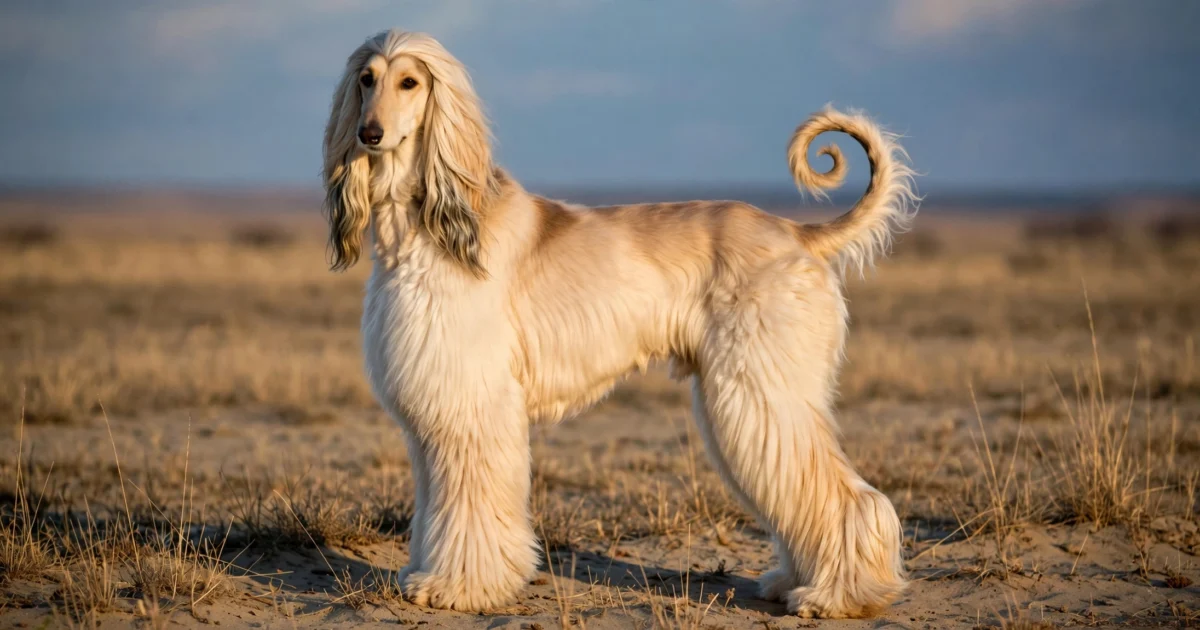
Baluchi Hound is an alternate name for the Afghan Hound, the long-coated sighthound that kennel clubs register under the Afghan Hound name. No major registry publishes a separate Baluchi Hound breed standard, so the checkable facts about size, coat, temperament and health come from the Afghan Hound record. The name still means something: it points to Balochistan, a region shared by southwestern Pakistan, southeastern Iran and southern Afghanistan, and it sits among older sighthound labels such as Tazi. dogsnzfci
That overlap is why the topic gets messy. Plenty of websites describe the Baluchi Hound as a hidden desert breed with its own pedigree, personality and standard. Neither FCI, the AKC nor the Royal Kennel Club supports that picture. This guide keeps two layers apart: what is documented for the Afghan Hound, and what is regional usage, folklore or sales language. Every section tells you which layer you are reading. petcuriousaltransit
Table of Contents
What Is a Baluchi Hound?
In breed references, a Baluchi Hound is an Afghan Hound listed under a regional alternate name. “Baluchi” refers to the Baloch people and to Balochistan, and “hound” signals a dog that hunts by sight and speed rather than by scent. Alternate-name lists for the Afghan Hound put Baluchi Hound beside Tazi, Balkh Hound, Kabul Hound and Barakzai Hound, which reads like a map of places where these dogs were noticed rather than a list of separate breeds. redzet
In everyday searching, three different things get called a Baluchi Hound:
- The Afghan Hound under another name. This use is documented and is the safest reading.
- Local sighthound-type dogs in and around Balochistan. Plausible, but no registry, standard or study found during research defines them as a distinct population.
- Any dog a seller tags with the name. Impossible to verify without paperwork.
Baluchi Hound, Afghan Hound and Tazi: A Quick Name Map
| Term | What it usually refers to | Status |
|---|---|---|
| Afghan Hound | The breed recognized by FCI (Standard No. 228), the AKC and the Royal Kennel Club | Recognized breed with a written standard |
| Baluchi Hound | An alternate name for the Afghan Hound, also used loosely for dogs tied to Balochistan | A name, not a separately standardized breed |
| Sage Baluchi / Sage Balochi | Another alternate name listed for the Afghan Hound | Name variant |
| Tazi / Tazy | A broad word for sighthounds; also an Afghan Hound alternate name and the name of Central Asian types | Depends on context |
The Tazi row deserves a second look. In many Turkic and Iranian languages the word simply means a sighthound, and it has been applied to Salukis, Afghan Hounds and Taigans alike. One Central Asian type, the Kazakh Tazy, received provisional FCI recognition as its own breed in 2024, which shows that a regional hound becomes a recognized breed only after a written standard, a registry and genetic work are in place. Nothing comparable exists for a stand-alone Baluchi Hound. Afghan Hound +2
Is the Baluchi Hound the Same as the Afghan Hound?
For registration purposes, yes. Baluchi Hound is a synonym, and every standard you can actually read is written for the Afghan Hound. FCI lists the breed as Standard No. 228 in Group 10 (Sighthounds), Section 1 (long-haired or fringed sighthounds), with Afghanistan as the country of origin and Great Britain holding the patronage. The AKC places it in the Hound Group and recognized it in 1926. Neither body publishes a separate description of the Baluchi Hound. fci.be/Nomenclature/Standards/228g10-en.pdf +2
So why do sources disagree? Mostly because they describe different layers. Kennel-club pages describe the registered breed. Content-farm pages invent a distinct desert breed, usually with dramatic claims about ancient tribes and extraordinary abilities, and none of those claims point to a registry or a study. Some encyclopedic summaries add one genuine detail: the Bell-Murray hounds that reached Scotland in 1920 are described as coming from Balochistan. That detail is probably where the Baluchi label draws its weight, and the history section below unpacks it. Unleashed Secrets of the Baluchi Hound – You Won’t Believe What This Ancient Breed Can Do – Penumbra Zone +2
Recognized Breed, Alternate Name, Regional Type, Claimed Ancestry
These four ideas get mixed together constantly, so it helps to define them:
- Recognized breed: a population with a written standard, a stud book and a governing club. The Afghan Hound qualifies.
- Alternate name: a second label for that same breed. Baluchi Hound qualifies.
- Regional type: dogs shaped by local use and local conditions, often without a registry. Real regional types exist, but nobody can say where their boundaries lie, and Tazi in its broad sense belongs here.
- Claimed ancestry: an individual owner’s statement, such as “his grandsire came from Balochistan.” Without a pedigree or records, it remains a story.
Appearance cannot settle any of this. A long-coated hound with a ringed tail might be a registered Afghan Hound, a cross with another sighthound, or a regional dog with no papers. Looks are consistent with a breed identity; they do not prove one.
Baluchi Hound History and Origin
The strongest statement the sources support is a modest one: the Afghan Hound is an old sighthound whose recorded history begins in Afghanistan and its neighbors. FCI credits Afghanistan as the country of origin, while the AKC’s sighthound overview admits the exact origin is unknown. The AKC’s history article treats the legend of an Afghan Hound boarding Noah’s ark as folklore and points out that, millennia ago, dogs fell into loose working categories rather than breeds in the modern sense. fci.be/Nomenclature/Standards/228g10-en.pdf +2
Wikipedia-derived summaries add that verifiable written or visual records tying today’s breed to specific Afghan owners or places are absent, and that genomic work places the Afghan Hound among the older, so-called basal breeds, most closely related to the Saluki. The Royal Kennel Club says the Afghan may have been developed from Salukis brought from neighboring Persia, a theory it presents as thought rather than proven. Afghan Hound +2
How the Dogs Reached Britain
The sources agree that British officers carried Afghan-type hounds home in the early twentieth century, and they disagree on small details. FCI’s historical note says the first Afghans arrived in Britain in the early 1900s and that a dog named Zardin won in spectacular style at the 1907 Crystal Palace show. The AKC’s account describes Zardin as probably born in Iran, bought in India by Captain John Bariff, and exhibited at Crufts in 1909, where his reception was so warm that Queen Alexandra asked to see him. Zardin inspired the first written standard in 1912, yet none of his bloodline survives in modern pedigrees. Both versions are given here because the sources do not reconcile them. fciakc
The Bell-Murray Strain and the Balochistan Link
This is the part of the story closest to the Baluchi Hound name. In 1920, Major and Mrs. G. Bell-Murray and Miss Jean C. Manson returned to Scotland with a group of hounds now called the Bell-Murray strain. The AKC describes them as steppe or desert types, with sparser, silkier coats and racier outlines. Wikipedia-derived summaries state that this group came from Balochistan; the AKC page does not name the place, so the Balochistan detail should be read as secondary-source information. akcdoc
A few years later, Mary Amps brought heavier-coated mountain dogs from around Kabul, known as the Ghazni strain, and the two camps argued over which type was authentic. According to the AKC, the strains ended up crossbred, and today’s Afghan Hound sits in the middle ground between them. A Balochistan thread is therefore plausible and probably underlies the alternate name, yet it is one thread in a mixed breed. It does not make today’s registered dog a purely “Baluchi” animal, and it does not prove that any given pet descends from Balochistan hunting dogs. akc
Claims about specific tribes, thousand-year pure lines or exceptional senses, which appear on many Baluchi Hound pages, do not trace back to any authoritative source and are left out here.
What Does a Baluchi Hound Look Like?
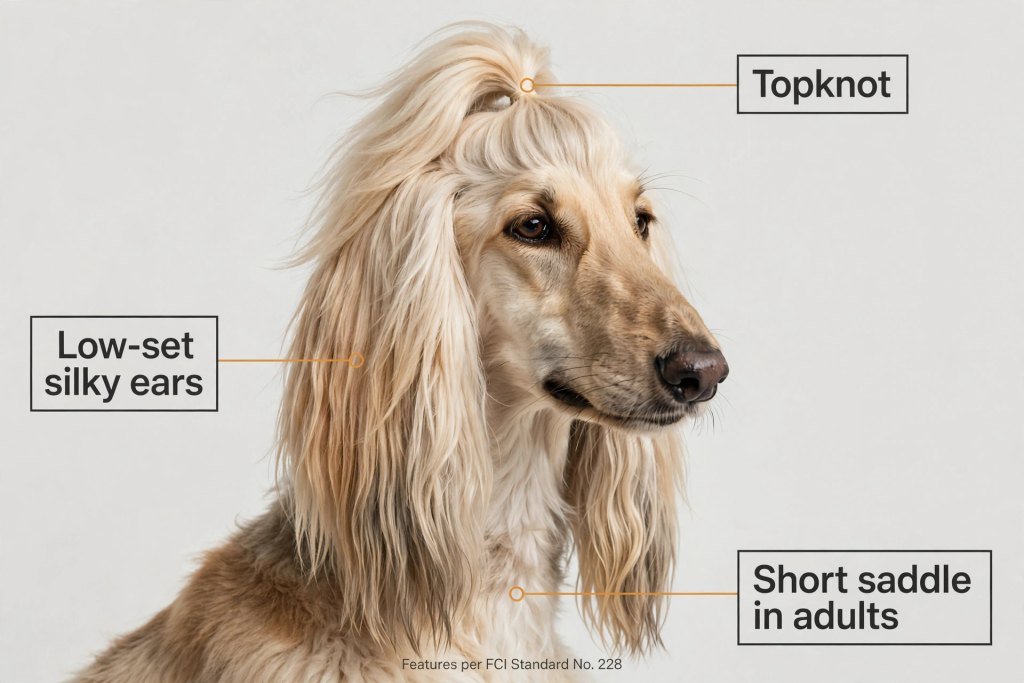
The description below is the Afghan Hound standard, because there is no separate Baluchi Hound standard to describe. FCI sums up the look as a blend of speed and power carried with dignity, with the head held proudly. fci
- Head: a long skull with a prominent occiput and a distinctive silky topknot, a slight stop and a long, strong muzzle. fci
- Eyes: preferably dark (golden is permitted), nearly triangular, with a slight upward tilt toward the outer corner, which creates the “Eastern” expression the standard keeps returning to. fci
- Ears: set low and carried close to the head, covered in long silky hair. fci
- Body: a long, strong neck, level back, short broad loin, and prominent hipbones set wide apart. fci
- Legs and feet: straight, well-boned forelegs and large feet with arched toes covered in long hair. fci
- Tail: low-set with a ring at the end, raised in motion and only lightly feathered. fci
- Coat: long, very fine hair on the ribs, flanks and quarters, with short close hair along the saddle of a mature dog and short hair on the face. fci
- Colour: all colours are acceptable except merle, which the standard rejects; white markings on the head or collar are highly undesirable. fci
Historical writing separates a lighter-coated desert or steppe type from a heavier mountain type, and the Royal Kennel Club notes that the breed’s size range reflects the different terrains the dogs worked. Modern show dogs blend both. akcthekennelclub
Baluchi Hound Size and Weight
The numbers that exist belong to the Afghan Hound. FCI gives an ideal height at the withers of 68 to 74 centimetres for males (about 27 to 29 inches) and 63 to 69 centimetres for females (about 25 to 27 inches), and it does not list a weight. The American standard describes dogs at 27 inches, give or take an inch, and about 60 pounds, with bitches at 25 inches, give or take an inch, and about 50 pounds. fci.be/Nomenclature/Standards/228g10-en.pdf +2
Treat any figure for a Baluchi Hound outside those ranges as a description of one individual dog, and treat any suspiciously tidy male-and-female table on a seller’s page as a copy of the Afghan Hound data.
Baluchi Hound Temperament
The temperament notes here come from Afghan Hound sources. FCI describes the breed as dignified and aloof, with a streak of fierce keenness, and adds that it is a hunter that will give chase whenever the chance arises. The AKC pairs the regal exterior with deep loyalty, a sensitive nature and strong attachment to its own people, and breed summaries note that many Afghan Hounds bond closely with one person and show little interest in fawning visitors. fci.be/Nomenclature/Standards/228g10-en.pdf +2
In daily life, a Baluchi Hound of this type tends to show:
- Independence: it may think before it complies rather than hanging on every cue.
- Reserve: polite aloofness with strangers fits the standard; extreme shyness does not, and FCI lists overly shy dogs as disqualified. fci
- Affection on its own terms: breed descriptions regularly mention a playful, clownish streak with familiar people. wikipedia
- Alertness and chase instinct: movement triggers pursuit, and a cat, a squirrel or a drifting plastic bag can start a run.
- Intelligence that does not look like obedience: Stanley Coren ranked the breed last among 138 breeds for obedience to commands, a ranking that says more about independence than about problem-solving ability. wikipedia
Individual dogs vary. Socialization, early experiences and breeding all shape the adult, and no description guarantees how a particular Baluchi Hound will behave.
Is a Baluchi Hound Good With Children?
It depends on the individual dog and the household, and no breed is automatically safe with children. Afghan Hound summaries tend to recommend supervision, and a Baluchi Hound’s natural reserve means it may withdraw from rough handling instead of tolerating it. A tall, fast hound can also knock over a toddler in a burst of play. cncb
Sensible guardrails: supervise every interaction, teach children never to hug, corner or disturb a resting dog, keep food and chew items off limits, and give the dog a retreat space. Families with very young children should ask whether they can manage a dog this large and this prey-driven alongside the attention a small child needs.
Baluchi Hound and Other Dogs
Socialization counts for more than the breed label. Many sighthounds enjoy running games with dogs they know, and that play can be fast and physical, so pair a Baluchi Hound with partners who enjoy the same style. Introduce unfamiliar dogs on neutral ground, on leash, in short sessions, and watch for stiff posture or fixed staring.
Small animals are a different matter. FCI notes the chase instinct, and Wikipedia-derived summaries say the breed may kill small animals and livestock. A home with cats, rabbits or very small dogs needs a management plan built on separation, supervision and secure barriers, and some households should skip the breed altogether. fciwikipedia
Baluchi Hound Exercise Needs
The Royal Kennel Club rates the Afghan Hound at more than two hours of exercise a day and suggests a large home with a large garden. That figure belongs to the registered breed; a Baluchi Hound by name alone has no separate benchmark. thekennelclub
Quality matters as much as minutes:
- Daily leash walks for routine and mental stimulation.
- Sprints inside a secure enclosure. Use tall, gap-free fencing and check it regularly.
- Lure coursing and similar sports. Breed summaries note that the modern Afghan Hound suits the lure course better than the hunting field, which gives the chase instinct a legal outlet. orvis
- Mental work such as scent games, trick training and food puzzles.
Recall deserves honesty. Because a Baluchi Hound may lock onto movement and run, a reliable recall in the living room does not guarantee one beside a road, a field of livestock or a wildlife trail. Keep off-leash time to enclosed spaces, and never allow unrestricted running near traffic.
Training a Baluchi Hound
Expect a thoughtful, sensitive learner, not a robotic one. Reward-based methods fit best: food, play and praise delivered promptly, in short sessions that end while the dog is still keen.
- Consistency: everyone in the household should use the same cues and rules.
- Early socialization: calm, positive exposure to people, sounds, surfaces and other dogs in the first months supports confident reserve rather than fearfulness.
- Leash skills: sighthound heads are narrow, so check that a collar or harness cannot slip over the head.
- Recall: build it on a long line, reward generously, and never punish a dog that returns late.
- Prey-drive management: teach “leave it” and “watch me,” and control the environment instead of relying on obedience alone.
Punishment-based training is a poor match. A sensitive dog that is startled or corrected harshly may shut down or become wary, and fear is a bad foundation for the recall you need most.
Grooming and Coat Care for a Baluchi Hound
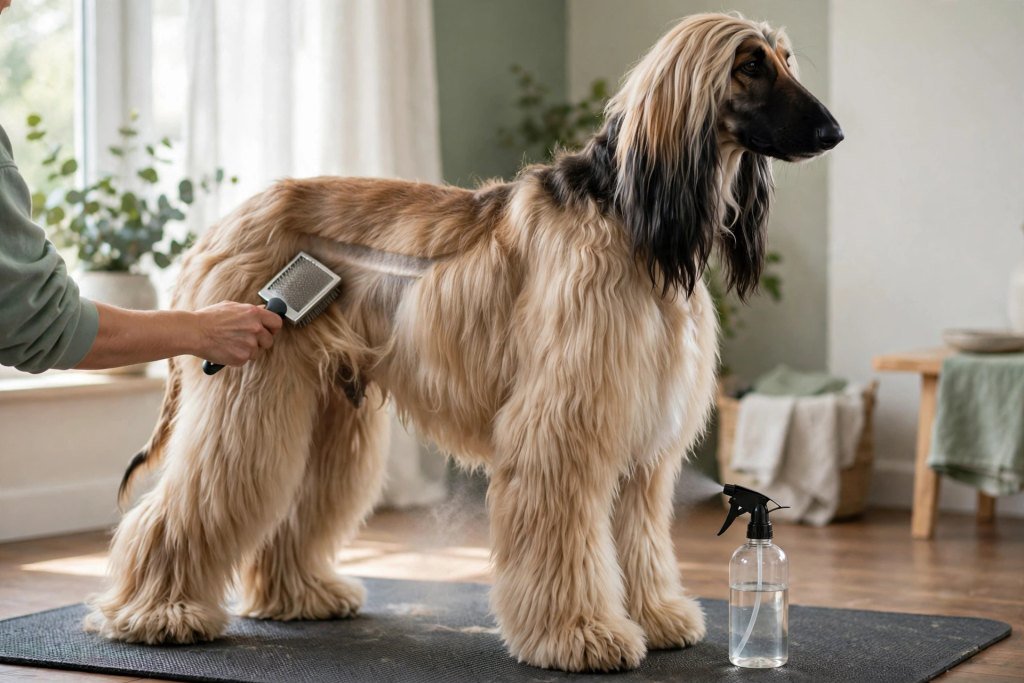
This section applies to Afghan Hounds, the recognized breed behind the name; a stand-alone Baluchi Hound has no unique grooming standard. The Royal Kennel Club lists daily grooming for the breed and notes that it sheds. In the show ring, FCI wants the coat to develop naturally, and clipping or scissoring counts against a dog. thekennelclubfci
- Brushing: work in sections down to the skin instead of skimming the surface, and pay extra attention behind the ears, under the legs and along the feathering, where mats form first.
- Bathing: brush out tangles before the bath, because wet knots tighten, then rinse thoroughly and dry completely.
- Ears: long, silky ears can dip into food bowls, so wipe them as needed and see a vet if you notice redness, odor or head shaking.
- Nails: trim regularly, as long nails alter the way a dog moves.
- Teeth: brush on a regular schedule; ask your vet about dental care.
- Professional help: choose a groomer experienced with long-coated sighthounds, and talk about a practical pet trim if a full coat is unrealistic for your household.
Baluchi Hound Health and Lifespan
Everything here is Afghan Hound information. No published health survey for a separately defined Baluchi Hound population turned up during research.
Lifespan. The Royal Kennel Club lists a lifespan of over 10 years for the Afghan Hound. A UK Kennel Club survey summarized by Wikipedia reported a median of about 12 years. Many websites quote 12 to 14 years or longer; read those as ranges, not promises. thekennelclubeuropetnet
Breed-associated concerns. The AKC’s health-testing list for the Afghan Hound shows the national breed club recommending hip, eye and thyroid evaluations. Breed summaries mention hip dysplasia, cancer, allergies, cataracts and other eye problems, hypothyroidism and bloat. The Afghan Hound is also among the breeds more likely to develop chylothorax, a rare condition in which fluid leaks into the chest. The Royal Kennel Club places the breed in Breed Watch Category 1, meaning no breed-specific points of concern have been flagged for judges, and notes that it offers no breed-specific DNA test package. hound group health testing requirements +3
Sighthound physiology. The AKC explains that sighthounds carry little body fat and many tolerate certain anesthetic drugs poorly. Veterinary literature adds that lean conformation raises the risk of hypothermia during anesthesia. If a Baluchi Hound needs a procedure, ask your veterinarian how they manage sighthound anesthesia before the day of surgery. akcbohrium
General care. Routine vaccination, parasite prevention, dental care and weight control apply to any dog. Some pages call the breed hypoallergenic, but no breed carries that guarantee, so allergic people should spend time with the dog first. Call a veterinarian promptly for breathing difficulty, a swollen abdomen with unproductive retching, limping, cloudy eyes or a sudden change in energy.
Is the Baluchi Hound Good for Hot Climates?
Not automatically. A name tied to an arid region is not proof of heat tolerance. Afghan Hound summaries describe the breed as shaped in the cold mountains of Afghanistan, with a coat suited to them, while the lighter-coated desert type mentioned earlier contributed to the modern dog. Treat each Baluchi Hound as an individual and watch it, not the label. hyphaakc
- Exercise early in the morning or late in the evening.
- Provide shade, fresh water and a cool indoor resting place.
- Check pavement with the back of your hand before walking.
- Never leave a dog in a parked car.
- Ask a groomer before trimming a coat for summer.
Cornell’s veterinary team lists heavy panting, seeking shade, whining, reluctance to play and drooling as early signs of overheating. Difficulty breathing, bloody diarrhea, vomiting, weakness, confusion, seizures or collapse are emergencies, and the dog should be moved into cool air with water and taken to a veterinary hospital immediately. cornell
Is a Baluchi Hound Good for Apartment Living?
It can work, but only if the exercise happens. Breed summaries describe a calm, quiet companion indoors when exercise needs are met, which makes size less of an obstacle than outdoor access. The Royal Kennel Club, however, suggests a large house and garden, so an apartment is not the ideal. vetstreetthekennelclub
A Baluchi Hound in an apartment needs a daily routine of long walks, reliable access to a securely fenced running area, a plan for door and balcony safety given its chase reflex, and enough enrichment to avoid boredom. If you cannot provide those on a busy week, a smaller, lower-drive dog is a fairer choice.
Baluchi Hound vs Afghan Hound
The table separates what is documented for the recognized breed from what is only regional usage or informal labelling.
| Factor | Afghan Hound (recognized breed) | Baluchi Hound (name or regional label) |
|---|---|---|
| Name | Official breed name used by FCI, AKC and the Royal Kennel Club | Alternate name for the same breed; informal label for some regional dogs |
| Recognition | FCI Standard No. 228; AKC Hound Group, recognized 1926 | No separate recognition found |
| Origin terminology | Afghanistan | Balochistan, across Pakistan, Iran and Afghanistan; one early British strain linked to the region by secondary sources |
| Appearance | Written standard (FCI) | No separate standard; varies by individual |
| Coat | Long, fine coat, short saddle, silky topknot | Same if the dog is an Afghan Hound; unknown for undocumented dogs |
| Temperament | Dignified, aloof, chase-prone | Same if an Afghan Hound; individual variation otherwise |
| Exercise | Royal Kennel Club: more than two hours daily | Plan for the same; no separate data |
| Grooming | Daily (Royal Kennel Club) | Depends on the coat; plan at Afghan Hound level for any long-coated dog |
| Prey drive | High; FCI notes the chase instinct | Assume high for any sighthound-type dog |
| Training | Independent; reward-based methods | Same approach |
| Availability | Registered litters through breed clubs and marketplaces | Marketplaces route the name to Afghan Hound listings |
| Pedigree and registration | Stud books, parent health-test records | Nothing specific; ask for Afghan Hound papers or accept an undocumented dog |
The practical rule: when the Baluchi Hound name appears next to registration papers, the papers will say Afghan Hound. When it appears without papers, it is a description, not a pedigree.
Baluchi Hound vs Saluki
The Saluki is a separate, recognized breed with its own standard; the Royal Kennel Club lists both in its Hound group. It is also a close relative, since genomic work places the Afghan Hound as most closely related to the Saluki. The Royal Kennel Club lists the Saluki at more than two hours of exercise a day, like the Afghan Hound, but with weekly grooming and a coat that comes in feathered and smooth forms. Afghan Hound +2
The comparison matters because the Baluchi Hound label sometimes lands on lean, lightly coated dogs from the Balochistan region that could be Saluki-type, Afghan-type or a mix. A name alone cannot sort them. If a seller says a dog is a Baluchi Hound but shows a short or lightly feathered coat, ask what the registered parents are rather than assuming a third breed.
Is the Baluchi Hound Rare?
The honest answer is that nobody can say. No reliable population estimate exists for dogs sold or described as Baluchi Hounds, partly because the name does not correspond to a registered population. For the Afghan Hound, the AKC’s 2025 popularity list placed it at No. 117 among 202 breeds, a little below the middle of the table, which describes American purebred registrations rather than a worldwide head count. akc
Rarity is also a poor reason to buy a dog. A dog’s suitability depends on your home, time and experience, not on how unusual its name sounds.
Baluchi Hound Price and Availability
There is no standard price for a Baluchi Hound, and any page quoting a single figure for the name is guessing. Marketplace pages that mention Baluchi Hound puppies list it as an alias on Afghan Hound listings, so a search for the name usually leads to registered Afghan Hound litters or waitlists. pawradepaction
What moves the price:
- Location and demand: regional breeder density affects both price and wait times.
- Pedigree and registration: a documented pedigree costs more to produce and verify.
- Breeder reputation: careful breeders spend on health testing, socialization and veterinary care.
- Health testing: hip, eye and thyroid results take money and time.
- Importation and transport: moving a dog across borders adds costs, paperwork and risk.
- Documentation: registration, vaccination and microchip records are part of what you are paying for.
Scam warning signs: a price far below comparable registered litters, pressure to pay a deposit before you see the parents, refusal to video-call or allow a visit, and a seller who leans on the exotic Baluchi Hound name instead of showing papers. Also consider adult Afghan Hounds placed through breed clubs and sighthound rescues.
How to Identify a Genuine Baluchi Hound
First decide what “genuine” means to you. If you want the registered breed, a genuine Baluchi Hound is an Afghan Hound with papers. If you want a regional dog from Balochistan, nobody can certify it against a standard, and you are choosing an individual, not a breed.
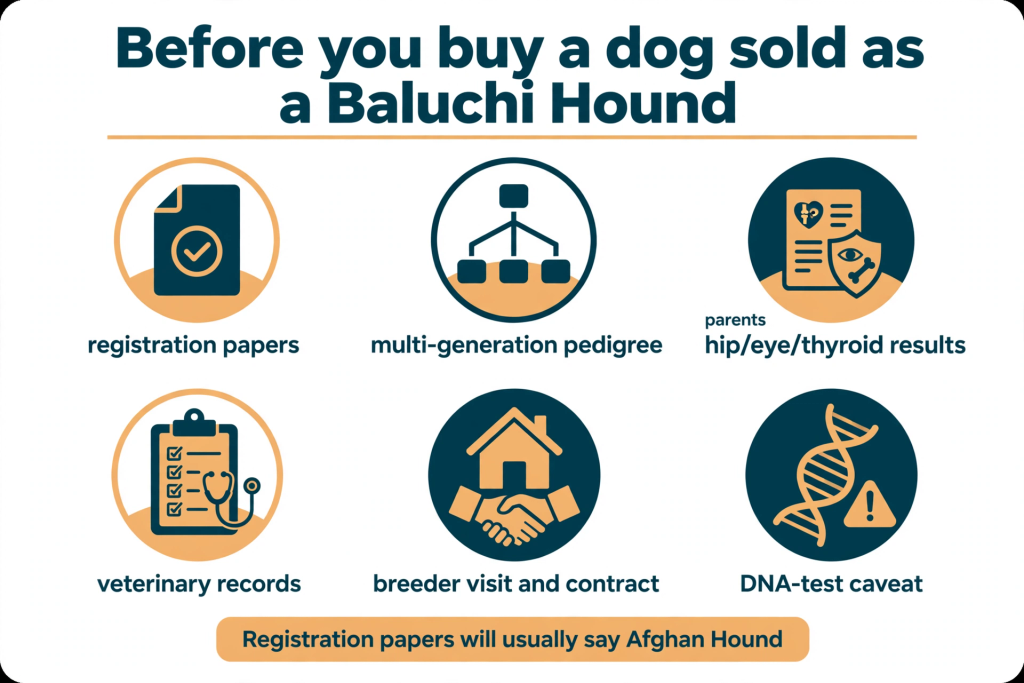
Photographs cannot establish either. Coats can be groomed, mixed dogs can look the part, and images are easily borrowed. Check instead:
- Registration: papers from a recognized registry such as the AKC, the Royal Kennel Club or an FCI member club.
- Pedigree: several generations, with names you can look up.
- Parents: meet them, and ask for hip, eye and thyroid results.
- Veterinary records: vaccinations, parasite control and the puppy’s examinations.
- Breeder history: references, a visit and a written contract.
- DNA tests: useful, but ask which reference breeds the lab uses, because a test can speak to Afghan Hound ancestry and cannot confirm a regional label that has no reference population.
Is the Baluchi Hound Right for You?
A Baluchi Hound suits you if most of these statements are true:
- You are active and can provide more than two hours of exercise daily, week after week.
- You have secure, tall fencing or access to a safe enclosed space.
- You have dog experience, ideally with sighthounds or independent breeds.
- You can commit to grooming nearly every day, or budget for a groomer who knows long coats.
- You enjoy patient, reward-based training and accept that recall around prey will never be perfect.
- You live without cats or small animals, or can manage separation reliably.
- You want a reserved, dignified dog, not a greeter for every visitor.
If several statements are false, a different breed will make you and the dog happier.
Frequently Asked Questions
Is a Baluchi Hound the same as an Afghan Hound?
Yes, for registration purposes. Baluchi Hound is an alternate name for the Afghan Hound, and the standards from FCI and the AKC are written for the Afghan Hound. The name can also be used loosely for regional sighthound-type dogs, which have no separate registry.
Where does the Baluchi Hound come from?
FCI lists Afghanistan as the country of origin for the recognized breed, and the AKC says the exact origin is unknown. The Baluchi label points to Balochistan, and secondary sources say one early British strain, the Bell-Murray hounds, came from there, though the AKC does not name the place. fci.be/Nomenclature/Standards/228g10-en.pdf +2
Is the Baluchi Hound a recognized breed?
Not under that name. The recognized breed is the Afghan Hound, and Baluchi Hound is listed as one of its alternate names. No major kennel club publishes a separate Baluchi Hound breed standard.
How big is a Baluchi Hound?
If the dog is an Afghan Hound, FCI gives 68 to 74 centimetres at the withers for males and 63 to 69 centimetres for females. The American standard gives about 27 inches and 60 pounds for dogs, and about 25 inches and 50 pounds for bitches. fciafghanhounds
What is a Baluchi Hound’s temperament?
Dignified, aloof with strangers, loyal to its own people and independent, with a strong chase instinct. Those traits come from Afghan Hound sources, and individual dogs differ.
Are Baluchi Hounds good family dogs?
Sometimes, in the right home. A Baluchi Hound needs a lot of exercise, secure fencing, careful supervision around children and a plan for any small pets. A reserved temperament means rough handling can be a poor fit.
How much exercise does a Baluchi Hound need?
The Royal Kennel Club rates the Afghan Hound at more than two hours daily. Combine leash walks with sprints in a secure enclosure and mental work, and avoid unrestricted off-leash running. thekennelclub
How much does a Baluchi Hound cost?
No authoritative price exists. Cost depends on pedigree, registration, health testing, location, import and transport. Treat any seller quoting one fixed price for a Baluchi Hound with caution.
Is the Baluchi Hound rare?
No reliable population figure exists for dogs sold under the name. The Afghan Hound ranked 117th of 202 breeds in the AKC’s 2025 popularity list, which reflects U.S. registrations only. akc
How long does a Baluchi Hound live?
For the Afghan Hound, the Royal Kennel Club lists over 10 years, and a UK Kennel Club survey summarized by Wikipedia reported a median of about 12 years. No lifespan data exist for a separately defined Baluchi Hound. thekennelclubeuropetnet
Conclusion
Baluchi Hound is a real name with a real geographic story, but not a separately standardized breed. Kennel clubs register the dog as the Afghan Hound, and every measurement, health recommendation and care guideline in this article comes from that record. The Balochistan connection is plausible and appears in secondary accounts of the Bell-Murray strain, while claims of ancient pure lines remain unproven. If you want a Baluchi Hound, you are in practice choosing a sighthound that needs space, grooming, patient training and secure containment, and you should ask for documentation before you commit. For more breed guides, visit HoundHow.
Sources & References
- Fédération Cynologique Internationale. FCI Standard No. 228: Afghan Hound (version dated 06.10.2026). https://www.fci.be/Nomenclature/Standards/228g10-en.pdf
- American Kennel Club. “Afghan Hound History: From Ancient Breed to Dignified Companion.” https://www.akc.org/expert-advice/dog-breeds/afghan-hound-history/
- American Kennel Club. “Afghan Hound” breed page. https://www.akc.org/dog-breeds/afghan-hound/
- American Kennel Club. “Fun Facts About the Afghan Hound.” https://www.akc.org/expert-advice/dog-breeds/fun-facts-afghan-hound/
- American Kennel Club. “Get to Know the Sighthound Breeds.” https://www.akc.org/expert-advice/dog-breeds/meet-sighthound-breeds/
- American Kennel Club. “Hound Group Health Testing Requirements.” https://www.akc.org/breeder-programs/breed-health-testing-requirements/hound-group-health-testing-requirements/
- American Kennel Club. “The Skinny on Sighthounds.” https://www.akc.org/expert-advice/health/the-skinny-on-sighthounds
- American Kennel Club. “The Most Popular Dog Breeds of 2025.” https://www.akc.org/expert-advice/dog-breeds/most-popular-dog-breeds-2025/
- The Royal Kennel Club. “Afghan Hound” (Breeds A to Z). https://www.royalkennelclub.com/search/breeds-a-to-z/breeds/hound/afghan-hound/
- The Royal Kennel Club. “Saluki” (Breeds A to Z). https://thekennelclub.org.uk/services/public/breed/display.aspx?id=1027
- Cornell University Riney Canine Health Center. “Summer heat safety tips for dogs.” https://www.vet.cornell.edu/node/9988
- Afghan Hound Times. “Breed standards: 1926 and 1948 AHCA standards compared.” https://times.afghanhounds.info/stanwork.html
- Show Sight Magazine. “Official Standard for the Afghan Hound.” https://digital.showsightmagazine.com/view/1026461
- Wikipedia. “Afghan Hound.” https://en.wikipedia.org/wiki/Afghan_Hound
- Tengrinews. “Historic day for Kazakhstan: Kazakh Tazy received breed recognition from FCI” (4 September 2024). https://en.tengrinews.kz/kazakhstan_news/historic-day-for-kazakhstan-kazakh-tazy-received-breed-263982
- Dog Bible. “Central Asian Tazi.” https://www.dogbible.com/en/breeds/central-asian-tazi
- Smith, C. et al. review summary, “Anesthesia of the sighthound.” https://www.bohrium.com/paper-details/anesthesia-of-the-sighthound/812270589145251842-15160


 admin